By Dr. Richard Nguyen, DO, FACS, FACOS | Board-Certified Surgeon | San Jose & Los Gatos, CA
At least once a week, a patient in my San Jose or Los Gatos office asks some version of the same question: "Should I take BPC-157 after my surgery?" Sometimes the compound is TB-500, GHK-Cu, or a "healing stack" a friend recommended. The question is reasonable. The answers people find online are not. So this post does something different from the wellness-clinic pages: it walks through what the evidence for peptides and surgical recovery actually consists of, how a surgeon reads it, and where the line sits between a promising hypothesis and a treatment I can recommend.
Before discussing any study, three facts frame the entire conversation:
None of this says the compounds do not work. It says that the burden of proof has not been met, and that the products people are buying are being sold outside the system that verifies purity, dose, and sterility.
When surgeons evaluate whether an intervention improves recovery, we sort the evidence into tiers. From weakest to strongest:
Every recovery intervention I recommend to my patients sits at tier four or five. Keep that in mind as we look at where the peptide literature sits.
BPC-157 (Body Protection Compound 157) is a 15-amino-acid fragment derived from a protein found in gastric juice. The published research base is real and fairly large, but almost all of it comes from one line of laboratory work, and nearly all of it is in rats. The studies report effects on:
Those findings are scientifically interesting. They are also tier two on the hierarchy above. As of this writing there are no adequate, well-controlled human trials showing that BPC-157 improves healing, reduces complications, or shortens recovery after any operation. There is essentially no published human safety data at the doses being sold online. A rat tendon study does not tell us what happens to an incision, an anastomosis, or a hernia repair in a person.
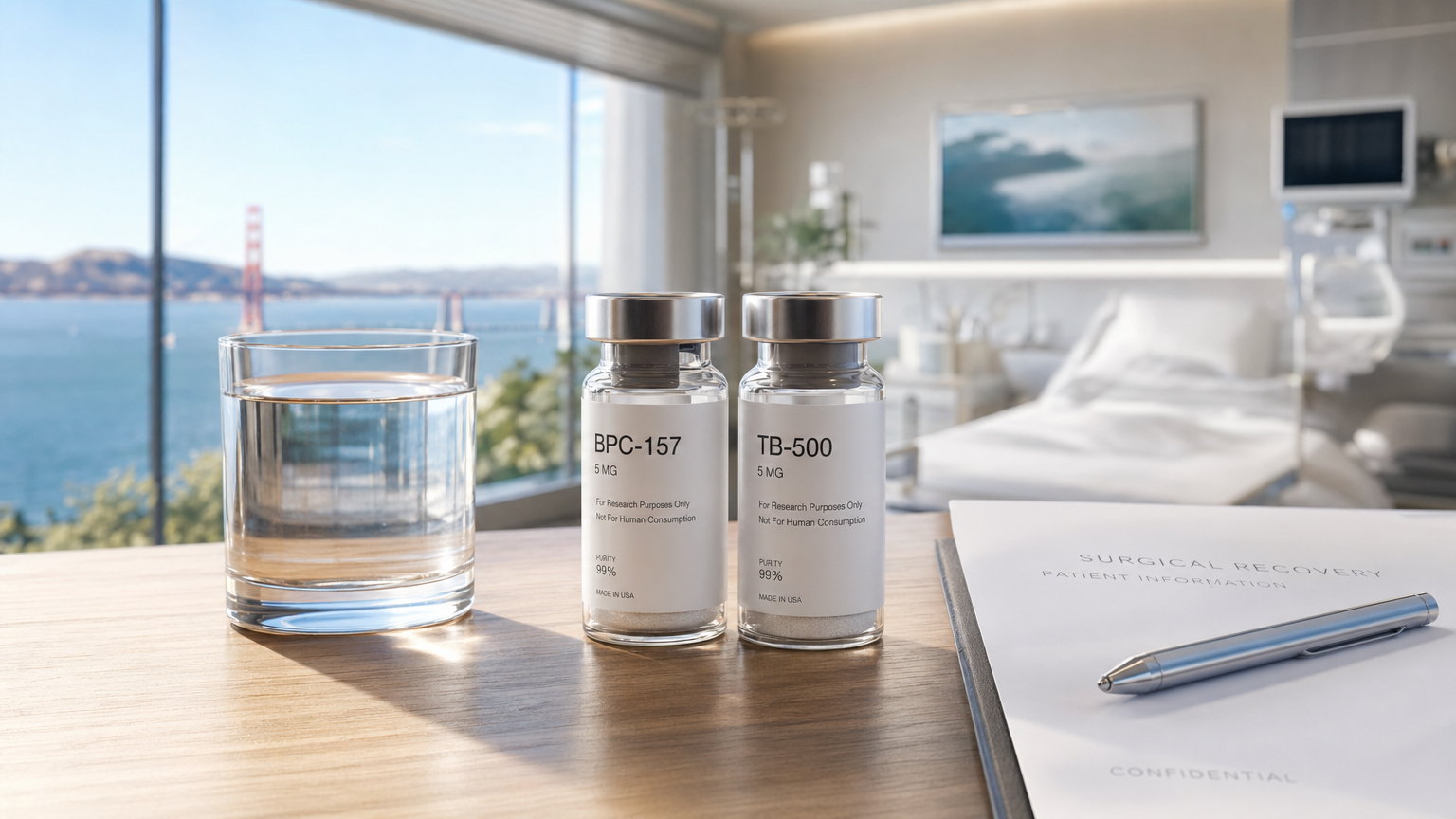
TB-500 is a synthetic fragment of thymosin beta-4, a naturally occurring protein involved in cell migration and tissue repair. Thymosin beta-4 itself has been studied in early-phase human trials for specific conditions such as certain wounds and eye surface disease, with mixed and preliminary results. TB-500 as sold online is a different, unapproved product, and there are no controlled human trials of it for post-surgical recovery. Again: laboratory signal, no human proof, no established human safety profile.
Patients sometimes tell me the absence of human trials is just a matter of pharmaceutical companies not funding them. That may be partly true, but it does not change what a surgeon can responsibly say. Surgery carries real, quantifiable risks: infection, bleeding, leaks, blood clots, poor wound healing. Anything I add to a patient's recovery has to clear a simple bar: does it reduce those risks in humans, and do we know it does not add new ones? For BPC-157 and TB-500 the answer to both halves is "we do not know." Angiogenesis, for example, is helpful for wound healing and potentially harmful in the presence of an undetected tumor. That is not a reason to panic. It is a reason to insist on the data.
This is the part that gets far less attention than it deserves. The following interventions have tier four and five human evidence behind them, and I discuss every one of them with my patients:
A patient who does these things well will almost certainly recover better than one who skips them and takes a peptide. Individual results vary, but the direction of the evidence is not in doubt.
I am not dismissive of peptide research. Some of it may eventually produce approved therapies, and I would welcome that. But "may eventually" is not a basis for post-operative care today. If you are considering an unapproved peptide, tell your surgeon before your operation so we can review interactions and timing, and put your real effort into the interventions that are proven. That is the candid version of the advice you will get at Lifetime Surgical, and it is the version I would give a member of my own family. For a broader look at how we approach this question, see our earlier post on 2026 FDA peptide regulation changes.
No adequate, well-controlled human trials exist. The evidence is almost entirely from rodent studies, which cannot establish efficacy or safety in people recovering from surgery.
It is widely sold online labeled "for research use only." It is not FDA-approved for human use, and FDA placed it in Category 2 of the 503A bulk substances list, which restricts legitimate compounding. Legality of purchase and appropriateness for human use are different questions.
Yes. Semaglutide and tirzepatide are peptide medications, but they are FDA-approved drugs backed by large randomized trials. That is the key distinction between approved peptide medications and research-only compounds.
We do not advertise or dispense compounded peptides. We offer an evidence-first peptide consultation and a pre-operative medication safety review, and we focus recovery planning on interventions with strong human evidence.
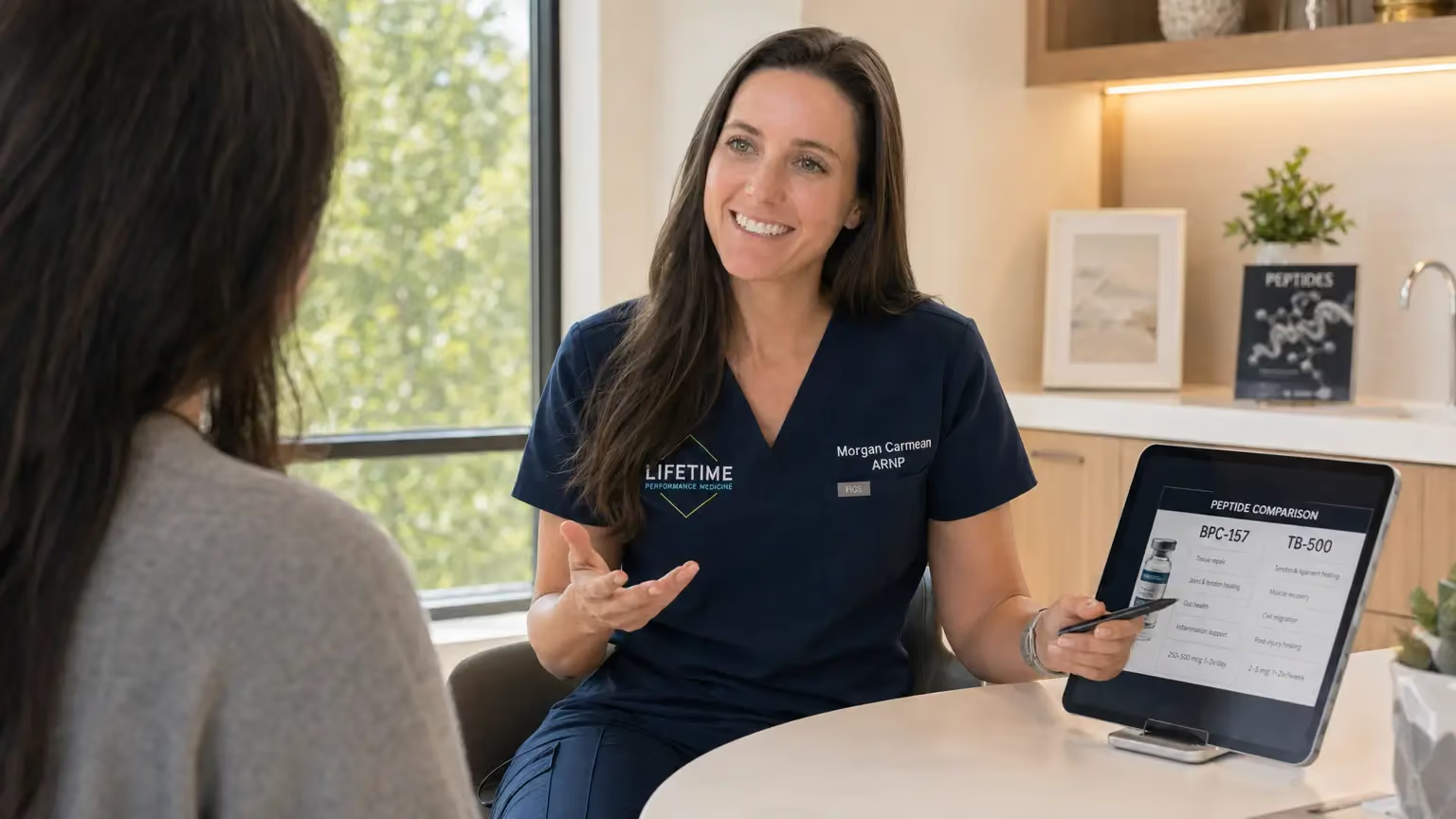
Peptide, hormone, and longevity services are provided through Lifetime Performance Medicine, the wellness and longevity division of Lifetime Surgical, founded by Dr. Richard Nguyen and located in Los Gatos. If you would like to discuss whether any of these therapies are appropriate for your situation, you can book a consultation with Lifetime Performance Medicine.
Lifetime Performance Medicine is an affiliated practice under the same physician ownership. Any therapy discussed is subject to individual medical evaluation, and not all compounds discussed in this article are FDA-approved. Individual results vary.
Wondering which surgical procedure might be right for your condition? We're here to help you understand your treatment options and develop a personalized surgical plan. Contact our office today to schedule a consultation.
Your path to improved health may be more achievable than you think—with advanced surgical techniques leading to faster recovery, reduced complications, and a significantly enhanced quality of life.
.avif)