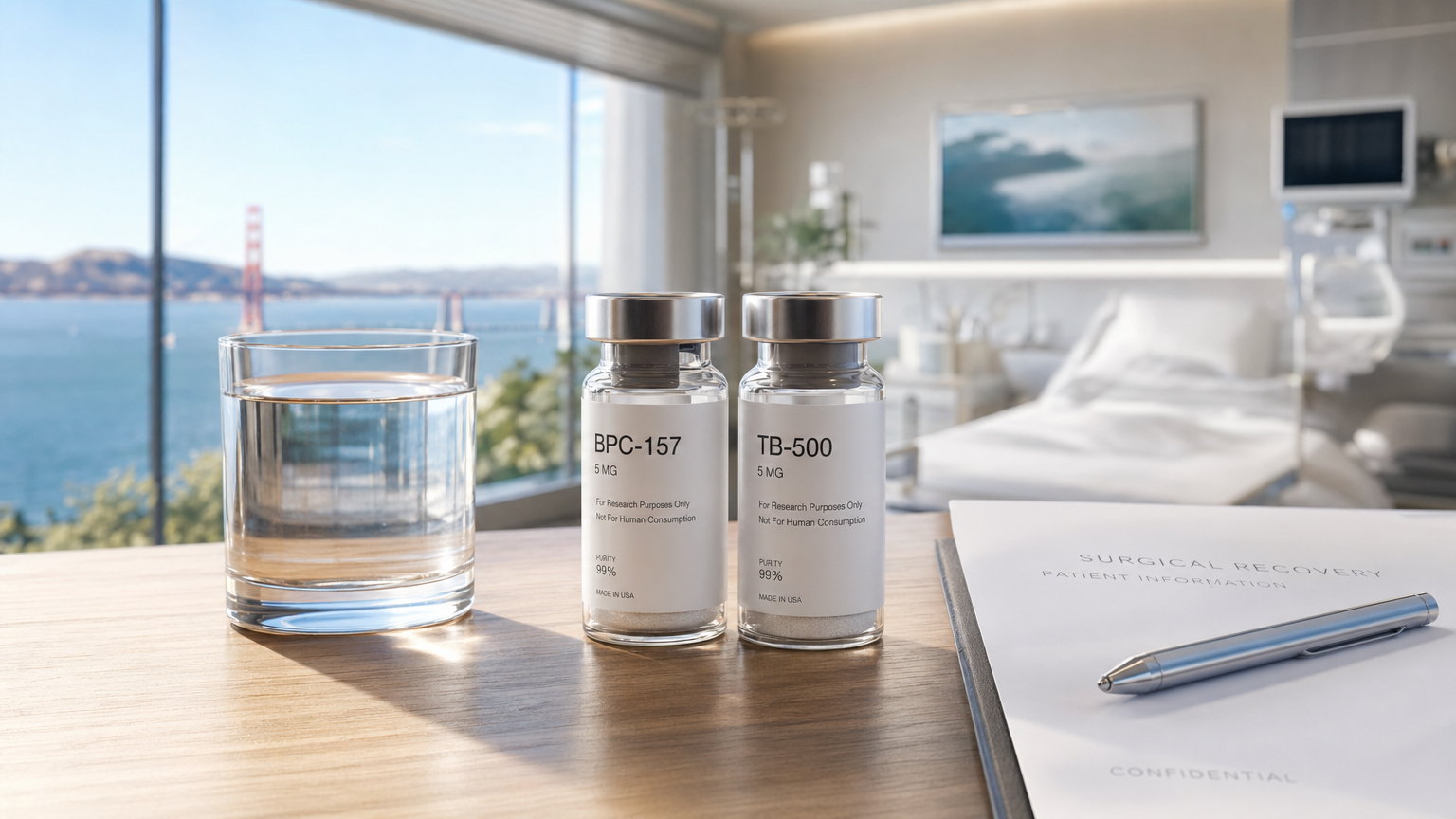
By Dr. Richard Nguyen, DO, FACS, FACOS | Board-Certified Surgeon | San Jose & Los Gatos, CA
Patients in our San Jose and Los Gatos medical weight loss program increasingly ask a question that did not exist a few years ago: "I'm on semaglutide (or tirzepatide). Can I add a peptide to it?" Usually the peptide in question is BPC-157 for gut side effects, a growth-hormone secretagogue to "protect muscle," or a stack recommended by a wellness clinic. It is a reasonable question with a surprising first answer: you are already on a peptide. Whether you should add another one depends on which of three very different categories that second compound falls into.
Semaglutide (Wegovy, Ozempic) and tirzepatide (Zepbound, Mounjaro) are peptide drugs. They are engineered chains of amino acids that mimic the gut hormone GLP-1 (and, for tirzepatide, GIP as well). What sets them apart from the peptides sold online is not their chemistry. It is the evidence and the oversight: both drugs went through large randomized trials involving thousands of patients, have FDA approval for specific uses, carry known side-effect profiles, and are prescribed and monitored by a physician. That is what an approved peptide medication looks like. Keep that picture in mind as we discuss the others.
When a patient asks whether peptides and GLP-1s "mix," they are almost always asking about the third category. The candid answer is that nobody has studied it.
This is the most frequent request. The rationale is that BPC-157 showed gut-protective effects in rodent ulcer and colitis models. There is no human trial of BPC-157 for GLP-1-related nausea, constipation, or reflux. Meanwhile, the evidence-based tools for those symptoms are well established: slower dose escalation, smaller meals, avoiding high-fat foods, adequate hydration and fiber, and, when needed, standard anti-nausea or bowel medications. We adjust these routinely and they work for most patients. Individual results vary.
Muscle loss during rapid weight loss is a legitimate concern, and it is one we take seriously in our program. The proven countermeasures are adequate protein (often 1.2 to 1.6 grams per kilogram of goal body weight per day) and resistance training two to three times a week. Growth-hormone secretagogues are unapproved, can raise blood glucose and insulin resistance, and have not been shown in human trials to preserve lean mass in patients on GLP-1 therapy. Raising glucose in a patient being treated for metabolic disease is the opposite of the goal.
Products marketed for fat loss (various melanocortin analogs, growth-hormone fragments, and others) are unapproved, unstudied in combination, and unnecessary. Tirzepatide already produces substantial average weight loss in trials on its own. Adding an unregulated product introduces unknown interactions without a demonstrated benefit.
GLP-1 medications slow stomach emptying. That changes how anything taken by mouth is absorbed, and it is why anesthesiologists ask patients to hold doses before surgery. It also means that any oral peptide product may behave unpredictably. Injected products bypass the gut but carry the purity and sterility concerns of unregulated manufacturing. And because GLP-1 therapy is often a bridge to, or an alternative to, bariatric surgery, we need a clean medication picture to plan safely. A patient who may later need a gallbladder operation or a hernia repair is best served by a medication list we can vouch for.
GLP-1 medications are the best-studied peptides in medicine. The compounds people want to stack with them are among the least studied. Combining a well-characterized drug with an uncharacterized one does not average out to "moderately safe." It adds unknown risk to a treatment that is already working. If side effects or muscle loss are your concern, we have proven ways to address both. Individual results vary, and every decision is made with you, based on your labs and your goals.
Yes. Semaglutide and tirzepatide are FDA-approved peptide medications backed by large randomized trials. That distinguishes them from unapproved research peptides sold online.
There is no human evidence for that use, BPC-157 is not FDA-approved, and the combination has not been studied. Proven measures for GLP-1 nausea include slower titration, smaller low-fat meals, hydration, and standard anti-nausea medication when needed.
Adequate protein and resistance training two to three times per week are the evidence-based approaches. Unapproved growth-hormone secretagogues are not proven for this purpose and may raise blood sugar.
Yes, always. It affects side-effect management, lab interpretation, and surgical planning if you ever need an operation. You will not be judged for asking.
Peptide, hormone, and longevity services are provided through Lifetime Performance Medicine, the wellness and longevity division of Lifetime Surgical, founded by Dr. Richard Nguyen and located in Los Gatos. If you would like to discuss whether any of these therapies are appropriate for your situation, you can book a consultation with Lifetime Performance Medicine.
Lifetime Performance Medicine is an affiliated practice under the same physician ownership. Any therapy discussed is subject to individual medical evaluation, and not all compounds discussed in this article are FDA-approved. Individual results vary.
Wondering which surgical procedure might be right for your condition? We're here to help you understand your treatment options and develop a personalized surgical plan. Contact our office today to schedule a consultation.
Your path to improved health may be more achievable than you think—with advanced surgical techniques leading to faster recovery, reduced complications, and a significantly enhanced quality of life.
.avif)