
Published April 4, 2026
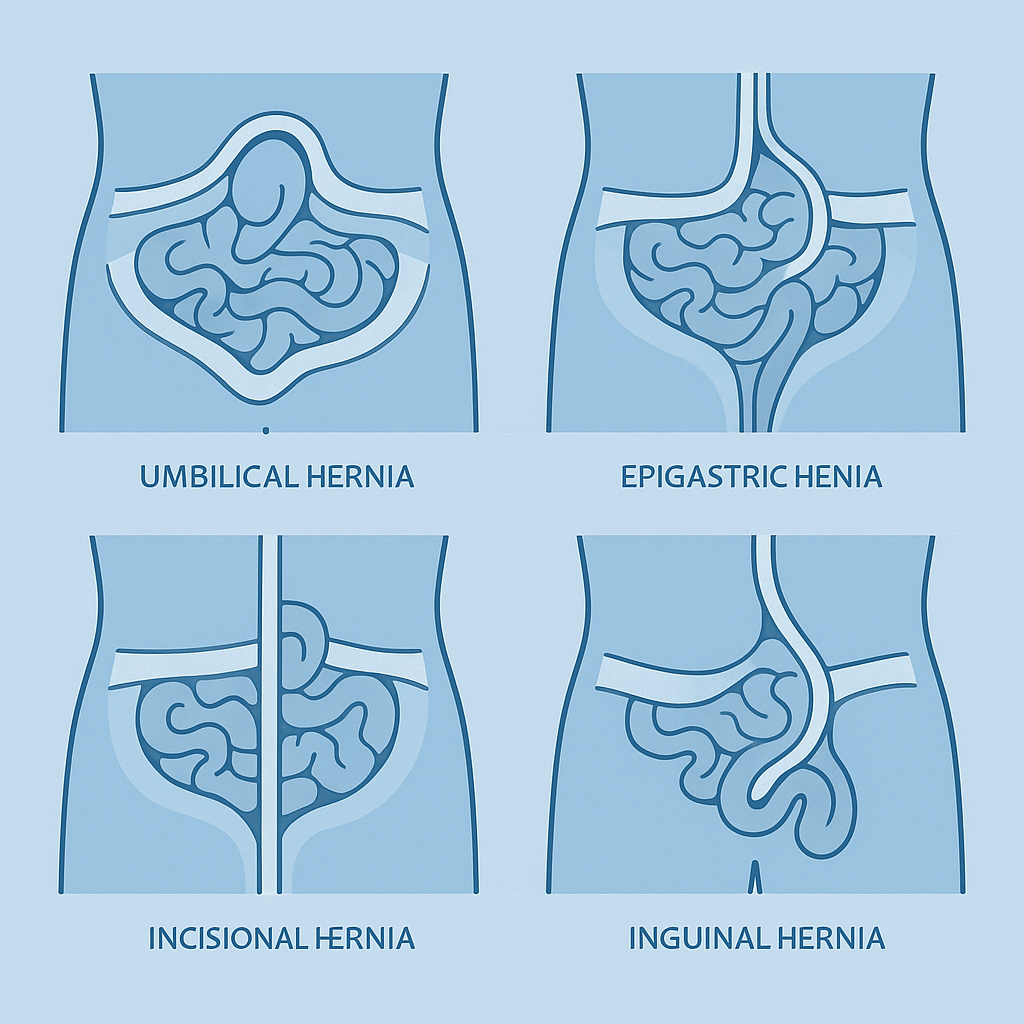
A hernia occurs when an organ or fatty tissue pushes through a weak spot in the surrounding muscle or connective tissue (fascia). Think of it like a bulge in a tire — the inner tube pushes through a weak spot in the outer rubber.
Hernias don't heal on their own. While some small hernias can be monitored with a "watchful waiting" approach, most hernias eventually require surgical repair to prevent complications like incarceration (the hernia becomes trapped) or strangulation (blood supply is cut off — a surgical emergency).
The most common type of hernia, accounting for about 75% of all abdominal wall hernias. Inguinal hernias occur in the groin area when tissue pushes through the inguinal canal. They're far more common in men than women.
Symptoms:
Learn more about inguinal hernia repair at Lifetime Surgical →
Ventral hernias occur through the front wall of the abdomen. This category includes several subtypes:
Read our detailed guide to ventral hernia repair →
A hiatal hernia occurs when the upper part of the stomach pushes through the diaphragm into the chest cavity. This type of hernia is closely associated with gastroesophageal reflux disease (GERD) and chronic acid reflux.
Symptoms:
Read our comprehensive hiatal hernia guide →
Despite the name, a sports hernia isn't a true hernia — it's a tear or strain in the soft tissue of the lower abdomen or groin. It's common in athletes who play sports involving twisting, turning, and sudden changes of direction.
Learn about sports hernia vs. inguinal hernia →
A hernia that returns after a previous repair. Recurrent hernias often require a different surgical approach than the original repair and benefit from a surgeon experienced in complex revision cases.
Not every hernia requires immediate surgery, but most will eventually need repair. Here are the key indicators:
Important: Only a qualified surgeon can determine the best approach for your specific situation. Schedule a consultation at our San Jose or Los Gatos office.
The traditional approach involves a single larger incision directly over the hernia. The surgeon pushes the protruding tissue back into place and reinforces the weakened area, often with surgical mesh.
Best for: Very large hernias, emergency repairs, some recurrent hernias, patients who cannot tolerate general anesthesia.
Recovery: 3-6 weeks before returning to full activity.
A minimally invasive approach using 3-4 small incisions (typically 5-12mm each). A tiny camera and specialized instruments are inserted through these ports, allowing the surgeon to repair the hernia from inside the abdomen.
Advantages over open repair:
Learn more about laparoscopic surgery →
The most advanced approach available. Robotic-assisted surgery uses the da Vinci Surgical System, providing the surgeon with 3D high-definition visualization, wristed instruments with 360-degree range of motion, tremor filtration, and enhanced ergonomics.
Dr. Nguyen is one of the most experienced robotic surgeons in the South Bay, with thousands of robotic procedures performed. Lifetime Surgical's robotic hernia repair program ranks #1 in search results for robotic hernia repair in San Jose.
Best for: Complex hernias, recurrent hernias, large ventral/incisional hernias, hiatal hernias.
Recovery: Many patients return to desk work within 3-5 days and full activity within 1-2 weeks.
Read about da Vinci robotic surgery →
The newest advancement. Good Samaritan Hospital recently acquired a next-generation Intuitive single-incision robot, and Dr. Nguyen is one of the first surgeons in the Bay Area trained to use it.
Surgical mesh is a medical-grade material used to reinforce the weakened tissue. Modern mesh materials are lightweight, flexible, and designed to integrate with your body's tissue over time. Mesh significantly reduces recurrence rates — from 10-15% with suture-only repair to 1-3% with mesh.
In select cases, the hernia can be repaired using the patient's own tissue without mesh. Best candidates include patients with small hernias, young healthy patients with strong tissue, patients with mesh allergies, and some umbilical hernias.
Dr. Nguyen is experienced in both techniques and will recommend the approach that offers the best long-term outcome.
Read our guide to non-mesh hernia repair →
Most hernia repairs are outpatient procedures — you go home the same day. Surgery typically takes 30-90 minutes depending on complexity. You'll be under general anesthesia.
Read our week-by-week robotic hernia repair recovery guide →
Dr. Richard Nguyen has performed more than 15,000 surgeries over his career. Hernia repair is one of his highest-volume procedures. Research consistently shows that surgeon volume directly correlates with better outcomes, fewer complications, and lower recurrence rates.
Lifetime Surgical offers every modern hernia repair approach: traditional open, laparoscopic, da Vinci robotic, single-incision robotic, and both mesh and non-mesh options.
Dr. Nguyen lives in Los Gatos and is deeply rooted in the South Bay community.
Unlike many practices, Lifetime Surgical offers comprehensive care including peptide therapy for enhanced surgical recovery (BPC-157, TB-500), thorough pre-operative optimization, and personalized follow-up.
Dr. Avery Joseph has joined the team, bringing additional expertise in laparoscopic and robotic surgery with shorter wait times.
For insured patients, hernia repair is almost always covered as a medically necessary procedure. Your out-of-pocket cost depends on your deductible, copay, and coinsurance. We accept all major insurance plans and have a robust self-pay program for uninsured or out-of-network patients.
The most common sign is a visible bulge in the abdomen or groin, especially when standing, coughing, or straining. You may also feel aching, burning, or a heavy sensation. Some hernias (like hiatal hernias) don't produce a visible bulge but cause symptoms like chronic heartburn. If you suspect a hernia, schedule an evaluation.
No. Hernias do not heal on their own and typically get larger over time. Surgical repair is the only definitive treatment. Trusses and hernia belts may provide temporary symptom relief but do not fix the underlying problem.
Both are excellent minimally invasive options. Robotic surgery offers advantages for complex hernias — the 3D visualization, wristed instruments, and tremor filtration allow for more precise tissue handling. For straightforward inguinal hernias, outcomes are similar. Dr. Nguyen will recommend the best technique for your situation.
Most patients return to desk work within 3-7 days after laparoscopic or robotic repair. Physically demanding jobs may require 2-4 weeks off. Open repair typically requires longer recovery.
Recurrence rates for modern hernia repair are low — typically 1-5% for primary repairs performed by experienced surgeons. Factors that reduce recurrence risk include choosing an experienced high-volume surgeon, following post-operative lifting restrictions, maintaining a healthy weight, and managing chronic cough or constipation.
We accept all major insurance plans, including PPO, HMO, Medicare, and most Medi-Cal plans. Hernia repair is considered medically necessary and is covered by virtually all insurance plans.
Don't let a hernia limit your life. Whether you're dealing with a new hernia or a recurrence after a previous repair, Dr. Nguyen and the Lifetime Surgical team are here to help.
Two convenient locations: San Jose (near Good Samaritan Hospital) and Los Gatos (near El Camino Hospital).
Request an appointment online to schedule your consultation. Most patients are seen within 1-2 weeks.
Dr. Richard Nguyen is a board-certified general surgeon with over 20 years of experience and 15,000+ surgeries performed. He specializes in minimally invasive and robotic surgery at Lifetime Surgical in San Jose and Los Gatos, California.
If you are comparing options after a hernia diagnosis, these pages answer the next questions South Bay patients usually ask before surgery.
Wondering which surgical procedure might be right for your condition? We're here to help you understand your treatment options and develop a personalized surgical plan. Contact our office today to schedule a consultation.
Your path to improved health may be more achievable than you think—with advanced surgical techniques leading to faster recovery, reduced complications, and a significantly enhanced quality of life.
.avif)


