
Published April 14, 2026
For some patients, the first question is not whether they need hernia surgery. It is whether the repair can be done without mesh.
That question is reasonable. Many people have read about mesh complications online, know someone who had a difficult recovery, or simply want the most natural repair possible. The important thing to know is this: non-mesh hernia repair can be an excellent option for the right patient, but it is not the right option for every hernia.
At Lifetime Surgical, Dr. Richard Nguyen evaluates each hernia individually. The goal is not to push mesh or avoid it at all costs. The goal is to choose the repair that offers the safest operation, the lowest recurrence risk, and the best long-term result for your anatomy and lifestyle.
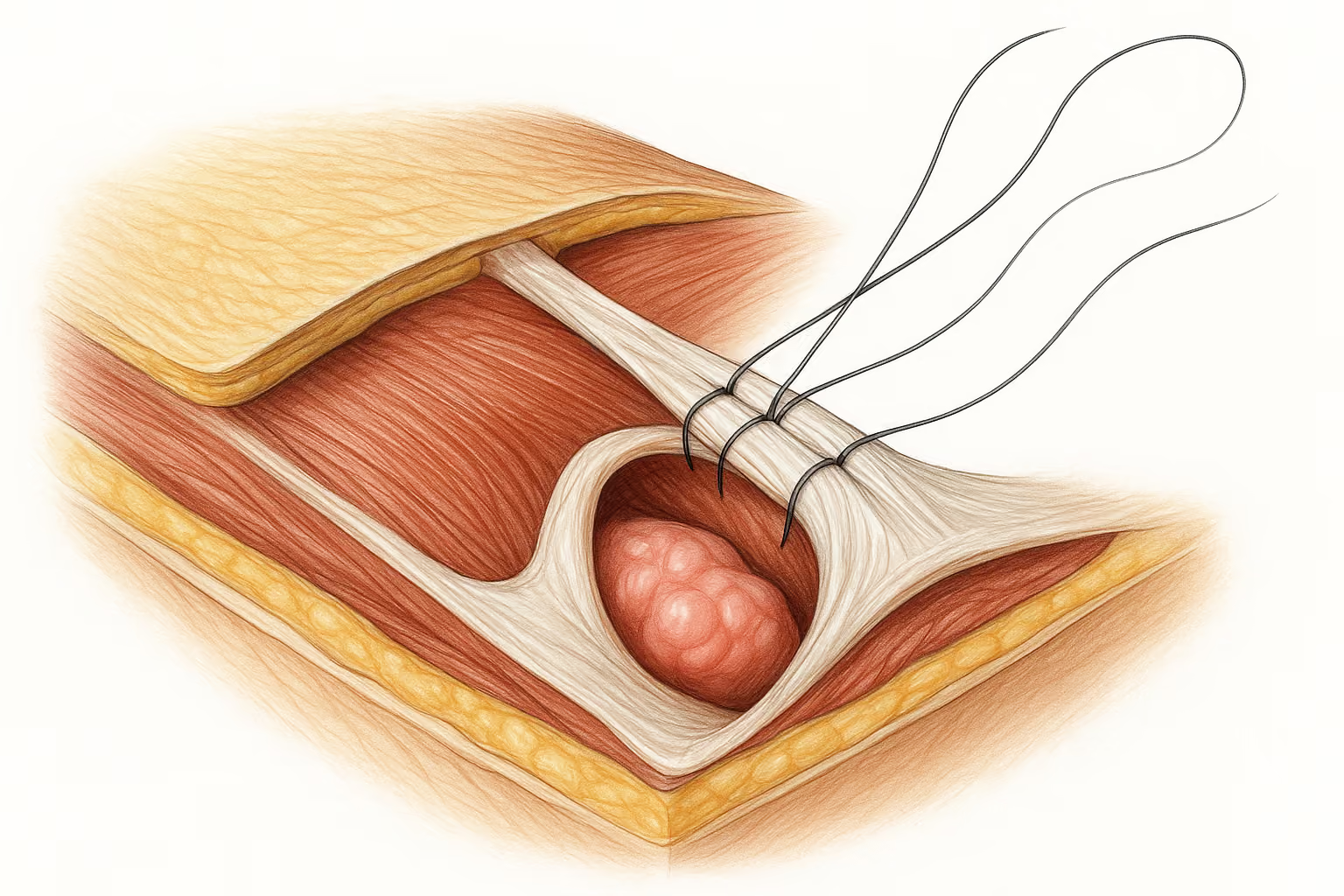
A non-mesh hernia repair, sometimes called a tissue repair, closes the defect using your own tissue rather than implanting surgical mesh for reinforcement.
Instead of placing a synthetic or biologic material over or behind the weakened area, the surgeon reconstructs and reinforces the tissue directly with sutures and careful technique. In the right setting, that can produce an excellent repair. In the wrong setting, it can create unnecessary tension and raise the risk of recurrence.
If you want a broader overview of repair options, read our Complete Guide to Hernia Surgery.
Non-mesh repair is usually most appropriate when several factors line up in your favor.
During consultation, Dr. Nguyen looks at the size of the defect, the quality of the fascia, your prior surgery history, your activity demands, your body habitus, and the likelihood that a suture-only repair will hold up over time.
Many patients want to avoid mesh, but in some situations mesh gives the best long-term result. That is especially true when the hernia defect is larger or the tissue is under too much tension.
Mesh is often the better option for:
If that is your situation, the right move is not to force a non-mesh repair. It is to choose the repair with the highest probability of lasting success. We cover that balance in more detail in our article on mesh vs. non-mesh hernia repair.
When it is truly a good fit, non-mesh repair has real advantages.
That said, the benefits only matter if the repair is durable. The best operation is the one that solves the problem and keeps it solved.
Patients sometimes hear "non-mesh" and assume it is automatically safer. That is too simplistic.
The real question is whether the repair can be done without excessive tension. If closing the defect without mesh puts too much pull on the tissue, the result may be more pain, slower recovery, or a higher chance the hernia comes back.
Key tradeoffs include:
That is why this should never be a checkbox decision. It should be a surgical judgment call made after a proper exam.
Non-mesh repair is most often discussed in the context of open tissue repair, especially for selected inguinal and umbilical hernias. For other hernias, especially larger or more complex defects, minimally invasive approaches and mesh-based reinforcement may provide a better long-term result.
Lifetime Surgical offers the full spectrum of modern hernia care, including:
The point is not to fit every patient into one method. It is to match the operation to the problem.
Dr. Nguyen's approach is pragmatic and individualized. In consultation, he will look at:
If a non-mesh repair gives you a strong, durable outcome, he will tell you. If mesh will clearly give you a better long-term repair, he will tell you that too.
Recovery depends more on the size and location of the repair than on the phrase "mesh" or "non-mesh." In general:
If you are comparing recovery timelines, our week-by-week hernia recovery guide is also helpful.
Not universally. It is better for the right patient and the right hernia. For other patients, mesh provides a more durable repair with lower recurrence risk.
Yes, some inguinal hernias can be repaired without mesh. The key question is whether the anatomy and tissue quality make a durable tissue repair realistic.
Some very small ventral hernias can be. Many larger ventral or incisional hernias are better served with reinforcement because recurrence risk is otherwise too high.
Not necessarily. Recovery depends on the type of hernia, the size of the repair, the technique used, and your activity demands afterward.
You need an in-person surgical evaluation. That is the only way to decide whether a non-mesh repair is both feasible and smart.
If you want to know whether non-mesh hernia repair in San Jose is a realistic option for you, the next step is a consultation. Dr. Nguyen can examine the hernia, explain your options clearly, and recommend the repair strategy with the best long-term odds of success.
Schedule a consultation with Lifetime Surgical.
Patients asking about non-mesh repair usually also want to know when robotic repair makes sense, when mesh is recommended, and which hernias can be treated with a tissue-only approach. These resources help you compare those paths before your consultation in San Jose or Los Gatos.
Wondering which surgical procedure might be right for your condition? We're here to help you understand your treatment options and develop a personalized surgical plan. Contact our office today to schedule a consultation.
Your path to improved health may be more achievable than you think—with advanced surgical techniques leading to faster recovery, reduced complications, and a significantly enhanced quality of life.
.avif)


