*Published April 7, 2026*
## What Is Laparoscopic Surgery?
Laparoscopic surgery — sometimes called "minimally invasive surgery" — is a technique that has been the standard of care in general surgery since the early 1990s. Here's how it works:
**How It Works**
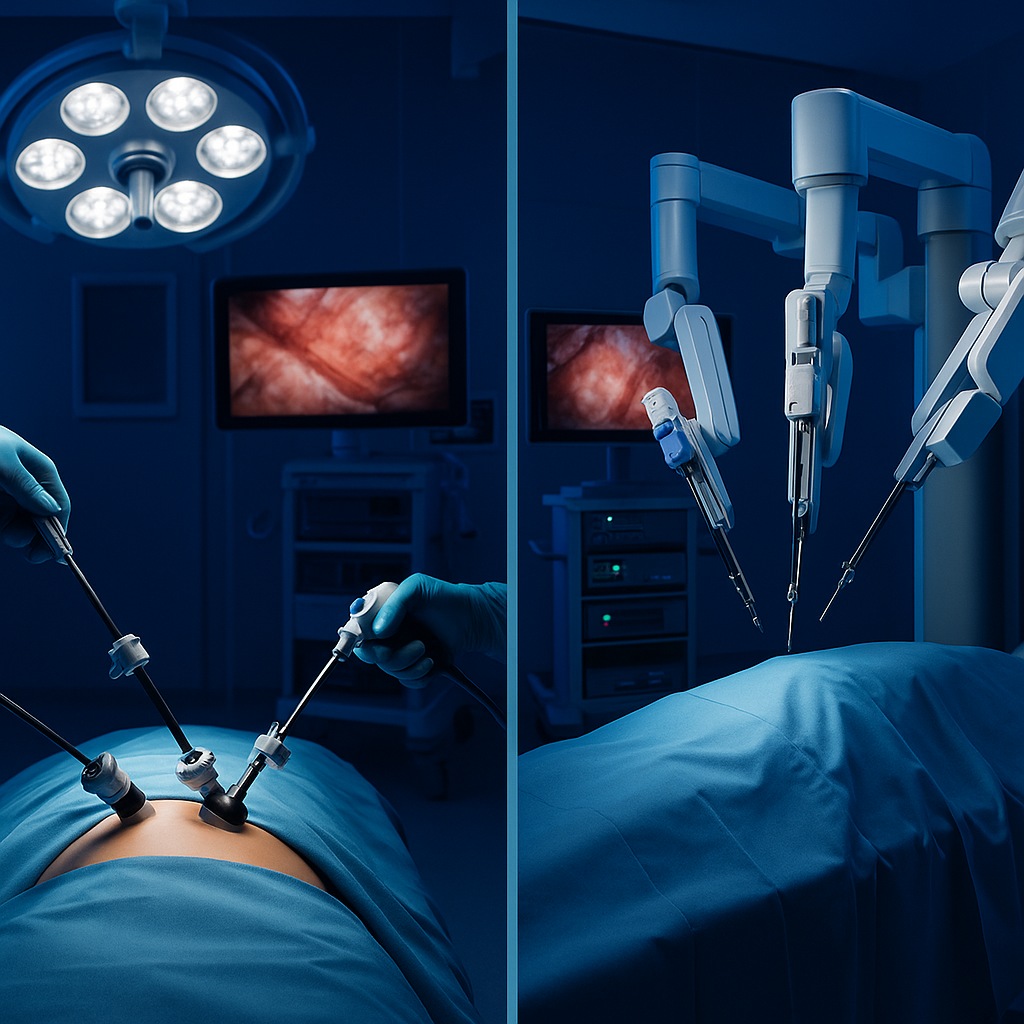
Instead of one large incision, laparoscopic surgery uses several small incisions (usually 0.5–1.5 cm each). A thin telescope called a *laparoscope* — connected to a tiny video camera — is inserted through one of the incisions, projecting a magnified image onto a monitor. The surgeon then inserts long, thin instruments through the other incisions to perform the operation while watching the monitor.
**Key Characteristics of Laparoscopic Surgery**
- Direct manual control by the surgeon
- Two-dimensional (2D) visualization on the monitor
- Straight, rigid instruments that move in limited directions
- Requires a skilled assistant to hold the camera and retract tissues
- High procedural volume — most general surgeons are highly trained in laparoscopy
**Procedures Performed Laparoscopically at Lifetime Surgical:**
- Cholecystectomy (gallbladder removal)
- Appendectomy
- Colon resection
- Hiatal hernia repair
- Inguinal hernia repair (in many cases)
- Gastric sleeve (in many cases)
---
## What Is Robotic Surgery?
Robotic surgery — specifically the **da Vinci Surgical System**, which Dr. Nguyen uses — is a form of computer-assisted surgery that builds on laparoscopic principles but adds a significant technological layer.
**How It Works**
The da Vinci system consists of three components:
1. **The Surgeon Console** — The surgeon sits at a console away from the patient, viewing a *stereoscopic* (3D), high-definition view of the surgical field.
2. **The Patient-Side Cart** — Four robotic arms hold the instruments and camera, positioned at the patient's incisions.
3. **The EndoWrist Instruments** — Tiny, articulating instruments that can rotate 540 degrees — far beyond the range of human wrists.
The surgeon controls the robotic arms from the console, translating hand, wrist, and finger movements into precise micro-movements. The system cannot move on its own — every action is surgeon-directed.
**Key Characteristics of Robotic Surgery**
- 3D, high-definition visualization
- Wristed instruments with 7 degrees of freedom (more range of motion than a human wrist)
- Motion scaling (surgeon's large movements become precise micro-movements)
- Tremor filtration (removes natural hand tremor)
- Improved ergonomics for the surgeon during long procedures
---
## Head-to-Head: Laparoscopic vs. Robotic
| Factor | Laparoscopic | Robotic (da Vinci) |
|--------|-------------|-------------------|
| **Visualization** | 2D monitor | 3D, high-definition stereoscopic |
| **Instrument range of motion** | Limited (straight instruments) | 540° wrist articulation (like a human wrist) |
| **Surgeon control** | Direct, manual | Direct, but mechanically translated through robotic arms |
| **Assistant dependency** | High (camera holder, retraction) | Lower (surgeon controls camera) |
| **Access for complex cases** | Limited in tight spaces | Superior in confined anatomical spaces |
| **Surgeon learning curve** | Very steep, long training | Different skill set from laparoscopy |
| **Hospital cost** | Lower | Higher (equipment and maintenance) |
| **Proven outcomes for standard procedures** | Excellent | Equivalent or better |
---
## Where Robotic Surgery Has a Genuine Advantage
The robotic platform isn't just a technological novelty — there are specific situations where it offers measurable advantages over traditional laparoscopy:
### 1. Hernia Repair (Particularly Complex Cases)
For **ventral hernias, incisional hernias, and recurrent hernias**, robotic surgery truly shines. The wristed instruments allow Dr. Nguyen to work in confined spaces with precision that's difficult to achieve with rigid laparoscopic tools.
Robotic hernia repair enables:
- **Retromuscular (Rives-Stoppa) repair** — placing mesh behind the abdominal muscles in a space that's challenging to access laparoscopically
- **Transversus abdominis release (TAR)** — a complex procedure for large, complex ventral hernias that is technically demanding with straight laparoscopic instruments
- **Better mesh placement** — critical for reducing recurrence rates
- **Intracorporeal suturing** — suturing inside the abdomen rather than requiring conversion to an open technique
For simple, primary inguinal hernias in straightforward anatomy, standard laparoscopy often works perfectly well. But when hernias are large, recurrent, or in challenging locations, robotic is Dr. Nguyen's preferred approach.
### 2. Hiatal Hernia and Anti-Reflux Surgery
Robotic surgery offers significant advantages for **hiatal hernia repair and Nissen or Toupet fundoplication** (anti-reflux surgery):
- The 3D view allows precise dissection of the hiatus (the opening in the diaphragm)
- Wristed instruments make suturing the wrap around the esophagus significantly easier
- Better control when working around the esophagus and vagus nerve
- Improved ergonomics during lengthy procedures
### 3. Bariatric Surgery (High-Volume Surgeons)
Dr. Nguyen performs gastric sleeve and gastric bypass using the da Vinci robot. Studies comparing robotic vs. laparoscopic bariatric surgery show:
- Equivalent or improved short-term outcomes at high-volume centers
- Particularly advantageous for patients with very high BMI (>50) where liver retraction and exposure are more challenging
- Very low conversion rates from robotic to open surgery
### 4. Single-Incision Surgery
When patients are candidates for **single-incision laparoscopic surgery (SILS)**, the robotic platform can enhance safety and precision. The Intuitive single-incision robot — the same system Good Samaritan Hospital recently acquired, making Dr. Nguyen one of the first in the Bay Area to use it — takes SILS to the next level.
### 5. Revision Surgery
When a patient needs **revision bariatric surgery** — a reoperation due to complications, inadequate weight loss, or weight regain — the anatomy is distorted and scarred from the previous surgery. Robotic surgery offers superior visualization and precision in these challenging reoperative fields, making it Dr. Nguyen's preferred approach for most revision cases.
---
## Where Laparoscopic Surgery Remains the Standard
For many routine general surgery procedures, traditional laparoscopy remains perfectly appropriate — and in some cases, is actually the preferred approach:
**Laparoscopy is typically preferred for:**
- **Simple cholecystectomy (gallbladder removal)** — highly routine, excellent outcomes with standard laparoscopy
- **Uncomplicated appendectomy** — laparoscopic appendectomy is the established standard
- **Standard inguinal hernia repair (primary, unilateral)** — often equally well-handled laparoscopically
- **Diagnostic laparoscopy** — when the goal is visualization and biopsy rather than complex reconstruction
The key point: **Not every procedure needs a robot.** The robot is a tool — and like all tools, its value depends on the job. Using robotic surgery for a straightforward gallbladder removal is like using a Ferrari to drive to the grocery store — it's technically possible, but overkill.
Dr. Nguyen is one of the few surgeons in the South Bay who is equally comfortable and experienced in both approaches, and he chooses the technique that makes the most sense for each individual patient and procedure.
---
## What This Means for Your Surgery
When you come to Lifetime Surgical for evaluation, Dr. Nguyen will recommend the approach — laparoscopic or robotic — that offers the best balance of safety, efficacy, and efficiency for your specific situation.
**Factors that influence the choice:**
- Type and complexity of your condition
- Previous surgical history (scarring, distorted anatomy)
- Your body habitus (BMI, abdominal wall thickness)
- Surgeon experience and comfort level with each platform
- Hospital equipment availability
What you *won't* get: pressure to choose one approach over another based on anything other than what's medically best for you. Dr. Nguyen's recommendation will always be driven by your clinical situation, not by technology preference or billing considerations.
---
## Dr. Nguyen's Robotic Experience
Dr. Richard Nguyen has performed more than **15,000 surgeries** over his 19-year career, including thousands of laparoscopic procedures and a significant and growing number of robotic operations. He was recently one of the first surgeons in the Bay Area to perform single-incision robotic surgery using the new Intuitive system acquired at Good Samaritan Hospital.
He also trained Dr. Avery Joseph, who joined Lifetime Surgical and brings additional expertise in robotic techniques for both bariatric and general surgery procedures.
This depth of experience matters: studies consistently show that surgical outcomes are directly correlated with volume and experience — particularly in complex procedures like hernia repair and bariatric surgery.
---
## Frequently Asked Questions
**Is robotic surgery more dangerous than laparoscopic surgery?**
No — when performed by an experienced surgeon, robotic surgery has equivalent or better short-term outcomes compared to laparoscopy for most procedures. The robot doesn't operate on its own — every movement is controlled by the surgeon. The primary differences are in visualization, precision, and access — not in fundamental safety profiles.
**Will my insurance cover robotic surgery?**
In most cases, yes. Robotic surgery is considered standard of care for many procedures, and commercial insurers and Medicare typically cover it. Coverage decisions are usually based on the procedure being performed, not the surgical platform. Our billing team will verify your coverage before surgery.
**Is Dr. Nguyen experienced with both approaches?**
Yes — extensively. Dr. Nguyen trained in both traditional open surgery and laparoscopic techniques during his surgical residency, and has incorporated robotic surgery as the technology has evolved. He is equally comfortable and highly experienced in both laparoscopic and robotic approaches.
**Will I have a choice between laparoscopic and robotic?**
Dr. Nguyen will recommend the approach he believes is safest and most effective for your situation. If you have a preference or concern, you should absolutely discuss it at your consultation — he'll explain his reasoning and help you understand the rationale for his recommendation.
**How long is recovery after robotic surgery compared to laparoscopic?**
For most procedures, recovery is similar between the two approaches — both are minimally invasive compared to open surgery, meaning smaller incisions, less pain, shorter hospital stays, and faster return to normal activities. The robotic approach may offer a slight advantage in complex cases where the precision of wristed instruments reduces tissue trauma.
**What is single-incision robotic surgery?**
Single-incision robotic surgery (SILS) is an approach where the surgeon performs a procedure through a *single* small incision — typically at the umbilicus (belly button) — rather than multiple incisions. The cosmetic result is essentially a invisible scar. Dr. Nguyen was one of the first surgeons in the Bay Area to use the new Intuitive single-incision robot, which represents the latest evolution of this technique.
**Does robotic surgery cost more?**
From the patient's perspective, out-of-pocket costs are typically equivalent to laparoscopic surgery for insured patients. The hospital bears the equipment cost; patient co-pays are generally based on the procedure, not the surgical platform.
---
## Which Approach Is Right for You?
The answer depends on your specific condition, anatomy, and surgical history. If you're facing a surgical decision, the most important thing you can do is:
1. **Get evaluated by an experienced surgeon** — someone who offers both approaches and can recommend the right tool for the job
2. **Ask about outcomes** — a surgeon who performs high volumes of both laparoscopic and robotic surgery will have better results than someone who does only one type
3. **Understand the recommendation** — ask *why* your surgeon recommends a particular approach
At Lifetime Surgical in San Jose and Los Gatos, Dr. Nguyen offers the full spectrum of surgical options — open, laparoscopic, and robotic — and has the experience to recommend the approach that's genuinely best for you.
---
**Related Articles:**
- [Robotic Surgery with the da Vinci Surgical System](/blog-posts/da-vinci-robotic-surgery-guide)
- [Recovery After Robotic Hernia Repair: What to Expect Week by Week](/blog-posts/robotic-hernia-repair-recovery-week-by-week)
- [Understanding Hiatal Hernia: Symptoms, Causes, and When You Need Surgery](/blog-posts/hiatal-hernia-symptoms-causes-surgery)
- [First in the Bay Area: Next-Generation Single-Incision Robotic Surgery](/blog-posts/single-incision-robotic-surgery-bay-area-first)
- [Our Bariatric Surgery Program in San Jose](/blog-posts/bariatric-surgery-changing-lives-san-jose)
## Related minimally invasive surgery resources
If you are comparing surgical platforms, these are the next pages most patients review before choosing a surgeon in San Jose or Los Gatos:
- [Laparoscopic surgery at Lifetime Surgical](/procedures/laparoscopic-surgery)
- [da Vinci robotic surgery guide](/blog-posts/da-vinci-robotic-surgery-guide)
- [Robotic hernia repair in San Jose](/robotic-hernia-repair-san-jose)
- [Hiatal hernia symptoms, causes, and surgery](/blog-posts/hiatal-hernia-symptoms-causes-surgery)
- [Meet Dr. Richard Nguyen](/meet-the-team/dr-richard-nguyen)
Lifetime Surgical serves patients across San Jose, Los Gatos, Campbell, Saratoga, Cupertino, Sunnyvale, Santa Clara, and the broader South Bay.

.avif)


